
15.11.08

12.11.08
Things read - Franz kafka
"Uncertainty, aridity, peace - all things will resolve themselves into these and pass away"
- Franz Kafka, Diaries 1914
- Franz Kafka, Diaries 1914
In process - territories yellow & blue
15/11 two updated images of these two paintings in process. Now to "rest" them for a while.


11.11.08
Things read - Georges Braque
"The aim is not to reconstitute an anecdotal fact but to constitute a pictorial fact"
- Georges Braque
- Georges Braque
Stock of appearances - Francis Ponge
"The sea, until she nears her limits, is a simple thing, repeating herself wave by wave. But you cannot approach the simplest things in nature without a good many formalities, the thickest things without a bit of thinning out. This - and also because he resents their oppressive immensity - is why man rushes to the edges or the intersections of the great things he wishes to define. For reason, plunged in the bosom of uniformity, gets perilously tossed about and runs into short supply: a mind in search of concepts must, to begin with, lay in stock of appearances."
Francis Ponge, Seashores 1942, trans. Margaret Guiton, in Selected Poems.
Francis Ponge, Seashores 1942, trans. Margaret Guiton, in Selected Poems.
6.11.08
Carlos Reygadas - Batalla en el cielo

Still from Batalla en el cielo.
Yesterday evening, I saw for the first time “Batalla en el cielo” (Battle in heaven) a film by Mexican Director Carlos Reygadas made in 2006. Reygadas was a student of international law, specialising in “armed conflicts”, but decided to take up film making.
The film has a raw existential quality which is contrasted with a very carefully constructed visual language reminiscent of Robert Bresson in some ways but impregnated with the almost surreal reality of urban Mexico. There is no fabrication in the cinema of Reygadas; no sets, no professional actors (as in the cinema of Bresson, Pasolini and others), nothing false and no spectacle. Reygadas uses the raw material of reality itself, Mexican reality, but not as a realist. Reality, under the cinematic gaze, undergoes a transformation, a transfiguration and acquires new meanings in an increasingly dreamlike world. Reygadas has said that he wants to show the inner life of the characters in his films not through the use of actors and conventional acting “skills” but through the cinematic process itself which is used to present and emphasize the physicality of the characters and how they experience things physically. The environments in which the characters move are of equal importance and are an extension of their inner states. The plot or story is of secondary importance, a typical feature of today’s dominant commercial cinema according to Reygadas.
This film has been controversial, mostly because there are numerous explicit sex scenes. The sex is not simulated either but real. Reygadas insists that he wishes to portray sex in the same way as eating or other everyday activities. Consequently, it is stripped of any glamour or pornographic intentions. Sex as provocation is usually a facile endeavour, and though here it does have a certain logic as a ritual of communion, it remains a problematic element. Everything in this film becomes part of the cinematic texture: one scene in particular is memorable, through a window we see Ana the female protagonist straddled over Marcos, the male protagonist, engaged in the sexual act. The camera then moves slowly away and begins a 360-degree pan revealing the urban landscape, rooftops, aerials, terraces etc…finally the camera returns to the window through which we see them both again, lying on the bed after the sexual act. It is difficult to say why but there is great tension in this moment of the film. Cars, traffic jams, the metro, buildings, interiors, faces, bodies, landscapes, the Mexican national flag, a catholic pilgrimage through city streets, the Our Lady of Guadalupe basilica etc are all part of the dense fabric that is Mexico city and which through a style of contrast reflect the fractured nature of Mexican society and experience.
An interview can be found here (in spanish) with the director.
5.11.08
Samuel Beckett and George Duthuit
"He congratulates Bonnard for having, in his last works, 'gone beyond possessive space in every shape and form, far from surveys and bounds, to the point where all possession is dissolved'. I agree that there is a long cry from Bonnard to that impoverished painting, 'authentically fruitless, incapable of any image whatsoever', to which you aspire, and towards which too, who knows, unconsciously perhaps, Masson tends. But must we really deplore the painting that admits 'the things and creatures of spring, resplendent with desire and affirmation, ephemeral no doubt, but immortally reiterant', not in order to benefit by them, not in order to enjoy them, but in order that what is tolerable and radient in the world may continue? Are we really to deplore the painting that is a rallying, among the things of time that pass and hurry us away, towards a time that endures and gives increase?"
Samuel Beckett and George Duthuit (second dialogue)
Samuel Beckett and George Duthuit (second dialogue)
Things seen - Liubov Popova

Composition, circa 1921, oil on wood panel, 9.5" x 7".
Liubov Popova. A painter that has always been very important for me since my student days.
4.11.08
Extreme painting
From the ground the course that a painter follows often branches out in different directions. It is only from a distance that one can see clearly how the paths might cross, join up, merge into each other or suddenly stop at a dead end. One way to navigate these
In this sense, extremism is not about transgression as such, nor necessarily the embracing of excess and decadent subjects and in my mind it is certainly not the absolutist or fundamentalist approaches to art such as so-called “radical” painting etc. Extremism is when there is the greatest tension between ones initial motivation on the one hand and all the means by which one tries to manifest this on the other (even when this runs the risk of total failure). Extremism is the ceaseless pushing of the medium and extracting what it has to offer in its most advanced manifestations. While there is always the attempt (humble rather than heroic) to come to terms with the anxiety of existence one should never underestimate pleasure in painting and the fragilty of this pleasure only makes it more poignant and serious.
1.11.08
Things seen - Jasper Johns

Green Angel (1990) by Jasper Johns. This painting always confounds me (as does much of Jasper Johns). I saw the big JJ show Jasper Johns. An Allegory of Painting, a couple of years ago at the Kunstmuseum Basel. The first room with a selection of small early drawings was were I spent most time. Occasionally people have told me that aspects of my painting are reminiscent of his work, especially the interlocking/overlapping forms etc. I find this particular painting very odd; the miroesque forms...especially the "eye" in the top left corner! I do find the way Johns builds up an image/surface interesting...though the finished painting can seem quite cold and distant.
28.10.08
Cy Twombly - (updated post)
Last night I attended the opening of the big Cy Twombly exhibition at the Guggenheim in Bilbao. He is undoubtedly an important artist. Certain works were stunning, but I was tired, too many cups of coffee during the day and a few glasses of cava had put me into daze. The installation didn't convince me either and along with the crowds there, it was impossible to see things properly...still, I enjoyed chatting to a few friends before I escaped and made my way home. I will go back and see it properly soon ( I need to work out what I really think of Twombly).
01/11/08 - Thinking back to the Twombly show I feel uncomfortable with the installation. I don't know who was ultimately responsible... I have seen more more considered installations of his work in the past. Here is an image of a show called "Blooming, a scattering of Blossoms and other things" which was at the Musée d´Art Contemporain in Avignon which looks much better:

01/11/08 - Thinking back to the Twombly show I feel uncomfortable with the installation. I don't know who was ultimately responsible... I have seen more more considered installations of his work in the past. Here is an image of a show called "Blooming, a scattering of Blossoms and other things" which was at the Musée d´Art Contemporain in Avignon which looks much better:

25.10.08
Things said - Robert Bresson

robert bresson, procès de jeanne d'arc 1962
"the domain of cinematography is the domain of the unsayable" (robert bresson from le monde, march 14, 1967 found in robert bresson: a spiritual style in film by joseph cunneen, 2003)
This could apply to painting for me: the realm of my painting is the realm of the unsayable.
24.10.08
Things seen - Georges Seurat

Seurat. Scaffolding, 1886-87. Divisions. Dark light. The figure. Intersections.
Things seen - Pierre Bonnard

Chris Ashley an artist and writer based in San Francisco sent me this image he had found of a drawing by Pierre Bonnard, study for "The Door into the Garden" 1924, pencil and watercolor on paper, 15.5 x 12 cm, private collection. I'm still taking on board just how important Bonnard is for me...this wonderful drawing was unfamiliar to me until now.

In process...
Two new paintings...both just about completed. I will leave them for a while: see how I feel about them in a few days after they have been hidden from my view. The first one is about 70x60cm and the second is approximately 60x50.


23.10.08
Homenaje a Tarzán
Here is a video of Homenaje a Tarzán, capítulo 1, La cazadora inconsciente (1969). It does not entirely capture the experience of seeing the original projected film though. The nature of this work makes one very aware of the medium of film itself and its unique "materialty of light"...

20.10.08
Rafael Ruiz Balerdi

After visiting the Gure Artea show last Friday I went to Galería Carreras Mugica to see an exhibition entitled: Balerdi. Homage to Tarzan, chapter 1: the unwitting hunter, curated by one of the artists selected for the Gure Artea prize, Asier Mendizabal. On show are works by the Basque artist Rafael Ruiz Balerdi 1934-1992. Balerdi is an extraordinary painter (unfortunately, little known outside Spain) and here I had the privilege of seeing an experimental film completed in 1969, which is the central piece in this exhibition. The film is a 16mm copy from the collection of the Filmoteca Española. Balerdi selected parts of a Tarzan film and traced them by hand, frame by frame directly onto celluloid. The result is a kind of dynamic animated drawing in black, white and grey in a fluid state of continual mutation and transformation. Through the specific and evident materiality of the medium of film itself, there is a constant shifting between representation and abstraction. The original Tarzan soundtrack is also maintained and lends a trance like rhythm to the images. Balerdi drew compulsively and this experimental film was an extension of this activity; taking gesture and repetition into a new realm. In the front space of the gallery a selection of wonderful drawings complements the film. There are few artists who embody so well the idea of FLOW developed by the French thinker Gilles Deleuze and although his interest in aspects of transcendental mysticism might seem unpalatable or even naïve for contemporary sensibilities it led him, indirectly, to bypass certain other concerns among his contemporaries and work with much greater liberty and directness. As a painter I feel a definite connection to his work. Credit to Asier Mendizabal for organizing this exhibition which shows that Balerdi is totally relevant today and absolutely contemporary.
19.10.08
Gure Artea 2008
I usually prefer to focus my attention on those things that I am drawn to and that I admire in some way. I’ll make an exception here though. On Friday afternoon I went to see Gure Artea 2008 at Rekalde (the main public contemporary art space in Bilbao). Gure Artea is held every two years and is the most important visual arts prize in the Basque Country. All the selected artists on this occasion have studied at the Fine Arts faculty at the University of the Basque Country or have had some connection with it. One of the selected artists Iñaki Imaz is a lecturer there. The main curator/juror of the show is Miren Jaio who has also spent some time teaching contemporary art history at the university. The whole thing is a bit of a closed shop and very symptomatic of the art scene here in the Basque Country. This would be excusable on one level of course if the works in question were of quality. The prize is financed by the Basque Government (with all the connotations that entails). A select group of so-called “cutting edge” artists, almost all graduates of the Fine Arts faculty have become almost institutional artists, reappearing in this prize and other major exhibitions over the last few years. This prize is interesting on one level at least, and that is as a sociological portrait of the art scene here in the Basque Country.

Maider López
Most of the art on show betrays an already conventionalised modus operandi, especially where new media is concerned. Maider Lopez has perhaps made the strongest video piece which documents an intervention in the city of Sharjah in the Arab Emirates. The lines of a football field were marked out in one of the public squares. The camera then documents the social interaction with this phenomenon. The editing though seems clumsy and I couldn’t help thinking of Francis Alÿs who has intervened in public spaces in a much richer way. There is a strong social/critical aspect underlying a lot of the work, the duo Iratxe Jaio & Klaas Van Gorkum for example, whose video piece shows the crude reality of urban development in the Basque city of Vitoria; the camera moves slowly and continuously from left to right showing buildings sites, the paraphernalia of construction, vast D.I.Y stores and builders merchants. When compared to say Catalan director Jaime Rosales’ ambitious and radical use of non-ideological cinema (often incorporating and transforming aspects of video art within the larger scope of cinema) a lot of this video work seems very poor and lacks any rigour. It is visually uninteresting and conceptually weak - employing and motivated by a predictable omnipresent “critical” rhetoric.
New media have an enormous potential for artists (just consider the expansive practice of Adrian Schiess for example, incorporating painting, installation and video) Unfortunately, and despite still being early days, a significant number of artists have adopted predictable ways of using them and have already created a kind of orthodoxy which begins in art school (certainly at the Basque Faculty of Fine Art).
Liam Gillick comes to mind when considering the work of Xabier Salaberria. His work appears to question the formalist and minimalist canons in modernism and its political implications but the objects he creates lack any value because there is no serious working through of ideas via the material of sculpture itself. The sculptural object is almost an afterthought. His piece Part II of an unbuilt Project is an example of this and perhaps of the greater malaise at the heart of this show: the artists operate in a territory which is almost exclusively theoretical yet theoretically limited. It also feels even somewhat outmoded as a discourse. One is left with the desire for something more open and anarchic. An intelligent proposal seems to mean working “conceptually” for most of these artists. However, thought and speculative approaches to art can also be made manifest through practices which manifest fluidity or materiality so absent in much of the current local scene.

Asier Mendizabal
Perhaps one of the most acclaimed younger artists in the Basque Country and Spain (and one of the three prizewinners) is Asier Mendizabal. Though his work is complex it essentially deals with the displacement of political, social & cultural symbols. Though his approach might seem intelligent and carefully focused, this in itself does not guarantee anything and ultimately his piece, Bigger than a cult, smaller than a mass (one, two backdrops), seems simplistic. It consists of two backdrops; the first made of recent newspapers and hanging in front of it a selection of different national flags.

Inaki Imaz
Some of the paintings by Iñaki Imaz (the only painter in the show) work well up to a point but I can´t help feeling his paintings are not pushed far enough. They could be more extreme and so have greater tension. The presentation doesn’t entirely convince me either. The framing, which I assume is meant to be “ironic” in some way, just looks awkward. However, the mysterious yellow painting reproduced here is very good indeed; in my mind the best piece in the whole show. Evidence that through its specific materiality and fragile limits, painting can still offer a rich, layered and more adventurous experience compared to other media.
This prize would benefit from being opened up, maybe to artists from the rest of Spain & Portugal or even internationally. A fresh curatorial angle on each occasion would also be beneficial. This of course would be good for Basque art and contextualize it in a larger sphere. With the spectre of nationalist politics and an immobile social and cultural situation I can’t see this happening soon. I left the exhibition feeling mildly irritated but mostly bored.
17.10.08
Bar Chicote

Morning coffee. Reflections at the bar; mental & real. In the studio now: there's a very fine line between absolute failure and success during the process of painting. I suppose the ideal attitude is one that would combine the utmost self-consciousness with a kind of innocence or even wreckless approach. The "Territories" paintings can be continually re-focused during their making until they reach a high degree of density (of light and time).
9.10.08

5.10.08
Villasana de Mena
A thirty minute drive to the south west from my town of Zalla, brings one to the town of Villasana de Mena; Mena being the name of the valley where this town is located. Although Zalla is in the Basque province of Vizcaya, Villasana is in the northernmost region of the province of Burgos, (Castilla -León). In just a few Kilometers the landscape and light change significantly. I spent a pleasant couple hours there this morning wandering around the streets... here are a few images I took with my humble mobile phone camera; shadows, the entrance to a building, a palace, a window...


3.10.08
New Drawings

Six new drawings have been added to the "recent drawings" gallery on the main website, follow this link: www.patrickmichaelfitzgerald.net. and open the "drawings" gallery. Here is one of them; Red interior, 2008, coloured pencil on paper, 32.5x25cm...

30.9.08
Fergus Feehily

Perimeters (cut), 2007 and Perimeters (silver), 2007
Fergus Feehily is an Irish artist based in Germany. He makes work which frequently combines or mutates different categories but usually manifests as painting or drawing in some form (more recently he has started to present certain objects on tables etc). He seems to deal with phenomenological questions in a very specific way, constantly inviting the viewer to see things in a fresh light by carefully moving the goalposts of our expectations. Wonderful work...have a look at his website here!
26.9.08
Painting - Territories VIII

Territories VIII (light in time), 2008, oil and spray paint on linen, 61x46cm


Painting - September (for Mikel)

September (for Mikel), 2008, oil, enamel, varnish & spray paint on MDF panel, 72x60cm

24.9.08
Things seen - Pierre Bonnard

One of my favorite paintings by Pierre Bonnard (Bonnard interests me increasingly as the years pass) L'amandier en fleurs, 1945, oil on canvas, 55x37.5cm, Musee national d'Art Moderne, Paris.
23.9.08
Drawing Center, New York
A selection of recent drawings are now on view at the Drawing Center's online viewing program in New York. Follow this link and use the search facilty.
22.9.08
Sunday walk
Yesterday morning, while out for a walk, I took this photograph. Does the world around me inform my work or is my vision of things in the world (how I see things) influenced and transformed by the visual experience of my work? Probably both things occur...there is a very dynamic interplay of this kind during the process of making and viewing drawings or paintings. An example; the way we see an interior wall bathed in light or shade has been transformed after Vermeer.


Territories - drawing
Here is a new drawing; coloured pencil on paper, 32.5x25cm, 2008. Like some recent paintings it employs a kind of mesh into which forms are embedded. Space subjugated to time!


18.9.08
Fragments
This afternoon I travelled the twenty odd kilometres into Bilbao by train in order to purchase materials from the art shop "Amaste" and to have some new drawings scanned. I've always liked the way the world presents itself through a train window; flickering images, reflections, things glimpsed for a moment then lost again, debris of the contemporary world strewn by the side of the tracks etc. Here are some fragments of my afternoon taken with my mobile phone camera:


16.9.08

Things seen - Francis Bacon

Francis Bacon - Composition, circa 1957-61, Oil on paper, 340 x 270 mm
Follow the link for more images from the Tate's collection: www.tate.org.uk
15.9.08
Mudanza

Mudanza, 2007, oil, ball point pen & acrylic on linen, 105x85cm
Revising my digital archive of paintings. Here's a painting made last year entitled "Mudanza". I like this one; its sparse airy structure, wind, moving clouds etc, shadows and demarcations......I wanted to make a painting with a "coastal" feel.
13.9.08
Transition
This painting appeared in an earlier post. It has been slightly modified...now completed it is entitled "Transition (interior-garden)" 2008, oil & enamel on canvas, 60x50cm.


Sherman Sam at the CCA Andratx, Mallorca
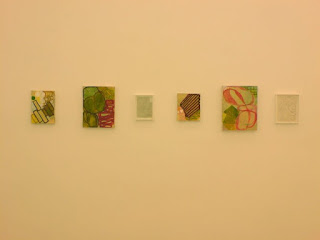
Another friend and colleague, Sherman Sam has an installation of paintings and drawings in a group show of contemporary artists based in London called "M25 around London". The venue is the "CCA Andratx", in Mallorca.

Andrew Bick at Von Bartha, Basel
Andrew Bick is currently showing his new paintings at Galerie Von Bartha in Basel. Pity I wasn't able to attend the opening; by all accounts it's a wonderful space and the work must look stunning there. Here is an image of a painting from the show called "trauser-shirth faded projected variant"...


10.9.08

Territories


Subscribe to:
Posts (Atom)